




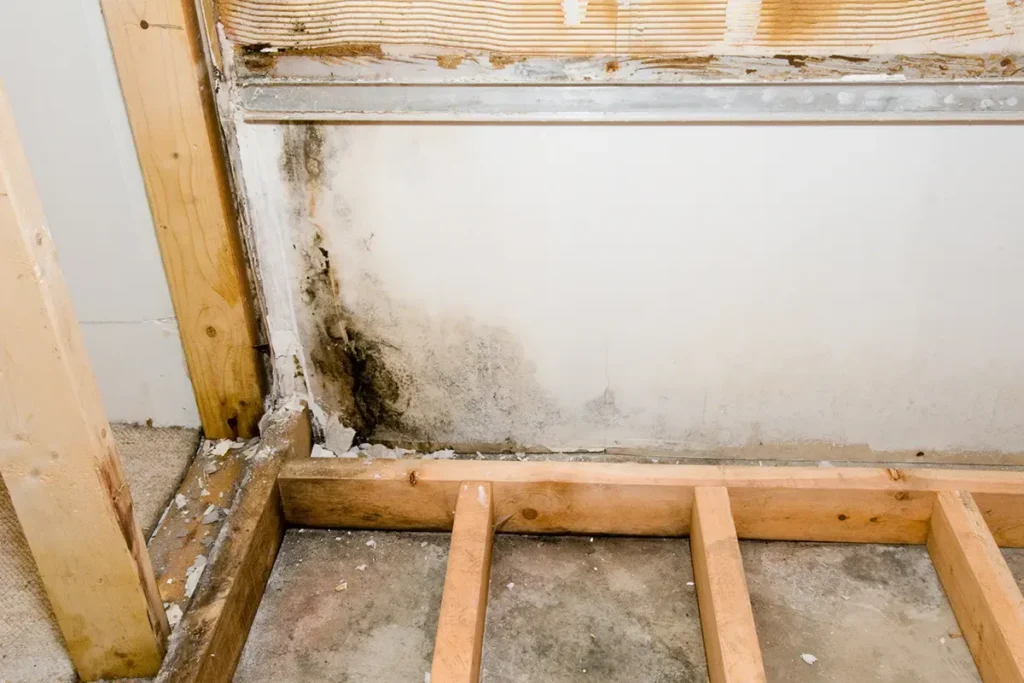
A musty basement smell almost always means moisture is feeding mold or mildew somewhere, even when you cannot see it. The odor comes from compounds that mold releases as it grows. The moisture usually comes from one of four places: water getting in from outside, a leak inside, humid air condensing on cool surfaces, or materials that hold dampness.
The smell tells you there is a moisture problem. It does not tell you how big the mold problem is. A damp cardboard box and a wall cavity full of growth can smell the same. Either way, finding the moisture source comes first. When growth covers more than about 10 square feet, the Illinois Department of Public Health says a professional should handle the mold remediation.
The Short Answer: Four Moisture Sources Behind a Musty Basement
- Water from outside. Seepage through foundation walls and floor cracks, poor grading, short downspouts, or a sump pump that cannot keep up.
- Water from inside. A slow plumbing leak, a weeping water heater, a washing machine hose, or an air conditioner or furnace condensate line.
- Humid air. Warm, damp air meets cool basement walls and floors, and the moisture condenses on them.
- Materials that hold moisture. Carpet over concrete, cardboard boxes, stored fabric, and drywall or wood touching the foundation.
When It Smells Tells You Why It Smells
The fastest way to narrow down the source is to notice when the odor is strongest. A week or two of paying attention usually points to one of these patterns:
- Worse after rain or snowmelt. Water is getting in. Look at the base of the walls, floor cracks, window wells and the sump pit. This is often water seepage from groundwater pressing against the foundation.
- Worse in July and August, even with dry walls. Humidity is the likely driver. Summer air carries more moisture, and when it touches a wall or floor that is cooler than the air, some of that moisture condenses into a film you may never see. Opening basement windows on a humid day adds more of it.
- Strong all year, and strongest in one corner or behind a finished wall. Something is growing where you cannot see it: behind drywall, under carpet pad or inside a wall cavity.
- Starts when the air conditioning or furnace runs. Look at the condensate line and drain pan, and at the ducts and equipment that sit in the basement.
- Lingering since a past leak or flood. Materials that got wet were never fully dried. Carpet pads, drywall and insulation hold moisture long after the surface feels dry, which is why proper flooded basement cleanup includes drying what you cannot see.
One more clue: if the smell reaches the upstairs rooms, basement air is rising through the house as warm air does.
Where the Smell Hides in a Finished Basement
In an unfinished basement, the source is usually easy to spot. Finished basements hide it. These are the places worth checking first:
- The lower edge of drywall and paneling on exterior walls, where seepage and condensation collect.
- Carpet pad, especially near exterior walls and around the floor drain.
- Under the stairs and inside closets built against the foundation.
- Around the water heater, washer and utility sink.
- The sump pit. An uncovered pit holds standing water and releases damp air into the room.
- Boxes and fabric stored directly on the floor or against a wall.
If a spot smells stronger up close, feels cool and damp, or shows staining or a white chalky residue on concrete, you have found a likely source.
Musty, Rotten Egg or Something Else? Match the Smell to the Problem
- Musty, earthy or damp. Mold or mildew feeding on moisture. The EPA notes that you may suspect hidden mold if a building smells moldy but you cannot see the source.
- Rotten eggs or sewage. Sewer gas, not mold. A floor drain that is rarely used can dry out and lose the water seal that blocks sewer gas. If water is coming up through the drain, that is a sewer backup and calls for sewage cleanup, not odor control.
- Natural gas. Leave the house and call your gas utility’s emergency line from outside.
- Nothing at all. No smell does not mean no problem. The American Lung Association notes that radon is a colorless, tasteless and odorless gas, and that testing is the only way to detect it.
Why Elk Grove Village Basements Are Prone to Musty Odors
Much of Elk Grove Village was built between the 1950s and 1970s. Many of those basements have since been finished with carpet, paneling or drywall placed against concrete that was never meant to stay perfectly dry, and some still rely on original drain tile and sump systems. Humid Cook County summers keep finished basements and crawlspaces at humidity levels mold-like, and spring groundwater presses against older foundations. The result is a basement that smells fine in January and musty by July. Cold outdoor air simply holds less moisture, and the smell tends to return with the first humid stretch of late spring.
What Fixes a Musty Basement, and What Only Covers It Up
These cover the smell without touching the cause:
- Air fresheners, candles and odor sprays.
- Painting over stained walls. The EPA says not to paint or caulk moldy surfaces.
- Bleach. The EPA says using a biocide such as chlorine bleach is not recommended as a routine practice during mold cleanup.
These address the cause:
- Keeping indoor humidity below 60 percent, ideally between 30 and 50 percent, which is the EPA’s guidance. A dehumidifier that drains on its own and a simple humidity meter make this easy to track.
- Stopping the water: grading, downspout extensions, sealed cracks, repaired leaks and a working sump system.
- Drying anything that gets wet within 24 to 48 hours. The EPA notes that in most cases mold will not grow if wet materials are dried in that window.
- Removing what cannot be saved. The EPA says absorbent materials such as ceiling tiles and carpet may have to be thrown away if they become moldy.
A dehumidifier alone fixes a humidity problem. It will not fix a leak, and it will not remove mold that is already growing. Carpet is a common holdout, since musty odors trapped in carpet can outlast the moisture that caused them.
Do You Need Mold Testing?
Usually not to confirm that mold is there. The Illinois Department of Public Health says that if you can see or smell mold, testing is usually not necessary and notes that no standards exist to judge acceptable mold levels. The EPA says that where mold growth is visible, sampling is usually unnecessary.
What is worth doing is finding the moisture. A good inspection uses moisture meters and thermal imaging to locate damp materials behind walls and under floors, so the fix targets the source instead of the symptom. Sampling still has a place, for example, to verify an area after remediation or when documentation is needed. Ask anyone who recommends testing what decision the results will change. For what to look for yourself, see these other early signs of mold.
When a Musty Basement Needs a Professional
- Visible growth covers more than about 10 square feet, the IDPH threshold for professional cleanup.
- The smell comes back after the space has been dried and humidity is under control.
- The odor is strongest behind finished walls or under flooring.
- The basement had a leak or flood that was not dried within 48 hours.
- Someone in the home has asthma or allergies and you want the source found quickly.
Illinois passed the Mold Remediation Registration Act to require mold remediators to register with the state and hold third-party certification. The Illinois Department of Public Health says registration will not take effect until its pending rules are adopted. Until then, ask for proof of certification. IDPH points consumers to certifications from organizations including the IICRC, ACAC, and NORMI.
A few questions separate a careful company from one selling a scare:
- Where do you think the moisture is coming from, and how did you find it?
- Which materials need to be removed, which can be cleaned, and why?
- How will you keep the work area separated from the rest of the house?
- How will we know the area is dry and clean when you are done?
Frequently Asked Questions
Can a musty smell in the basement make you sick?
The EPA notes that exposure to the compounds behind moldy odors has been linked to headaches, nasal irritation, dizziness, fatigue and nausea, and that more research is needed on typical indoor exposures. Treat the smell as a signal to find the moisture.
Why does my basement smell musty if I can’t see any mold?
Growth is often hidden behind drywall, under carpet pad or inside stored boxes, or damp materials are starting to break down before mold is visible. The EPA says a moldy smell with no visible source is a reason to suspect hidden mold.
Will a dehumidifier get rid of a musty basement smell?
Yes, if humidity is the only cause. The EPA recommends keeping indoor humidity below 60 percent, ideally 30 to 50 percent. If water is getting in or mold is already growing, the smell will come back.
How fast can mold grow in a damp basement?
The EPA advises drying wet materials within 24 to 48 hours to prevent growth in most cases. Once it starts, porous materials go quickly; see how quickly mold spreads on wood.
Who handles musty basements and mold near Elk Grove Village?
ProTech is based in Elk Grove Village and has served Chicagoland for more than 20 years. Our IICRC-certified technicians find the moisture source, remove what cannot be saved and dry the structure. The same crews handle water damage restoration in Elk Grove Village and the surrounding suburbs.
Get the Smell Out by Getting the Moisture Out
If your basement only smells musty in summer and a dehumidifier clears it up, you may not need us. That is the honest answer. If the smell keeps coming back, sits behind finished walls, or started after a leak or flood, ProTech’s IICRC-certified team will find the source and fix it properly. A dedicated project manager stays with you from the first call through the final walkthrough, and if water damage is involved, we work directly with your insurance adjuster.
Contact our team online. There is no minimum charge, and we answer 24/7.